The First Step to Better Hearing at AIM Hearing Bundaberg
At AIM Hearing Bundaberg, your journey to better hearing begins with a comprehensive, evidence-based diagnostic hearing assessment. This detailed battery of tests allows our hearing specialist to thoroughly evaluate your outer ear, middle ear, inner ear (cochlea), and auditory pathways to the brainstem where clinically indicated.
Our comprehensive hearing test protocol supports accurate differential diagnosis, helping your GP or ENT specialist identify the true cause of your hearing concerns, rule out unlikely conditions, and determine the most appropriate treatment or management plan.
Depending on your clinical needs, your assessment may include:
This comprehensive approach ensures we assess not just the level of hearing loss, but also speech clarity, sound tolerance, auditory processing, and hearing performance in noise.
At AIM Hearing Bundaberg, we follow Best Practice audiology standards to deliver precise diagnosis, personalised treatment recommendations, and superior long-term hearing outcomes.


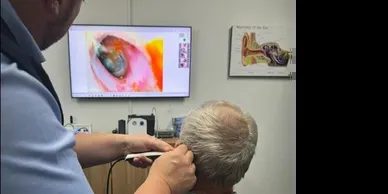
Our HD Video Otoscope ear examination provides a crystal-clear, magnified view of your ear canal and eardrum (tympanic membrane) in real time. This high-definition ear camera improves diagnostic accuracy by allowing detailed assessment of ear wax build-up, ear infections, perforated eardrums, inflammation, and other ear conditions.
It also enhances the safety and precision of procedures such as microsuction ear wax removal, as treatment is performed under direct visual guidance.
For clear hearing, the ear canal must be free from blockages and the eardrum must be healthy and intact.
If abnormalities are detected, our high-resolution ear images and video recordings can be securely emailed to your GP or ENT specialist to support faster diagnosis, referral, and coordinated care.
With HD otoscopy, you can see exactly what we see — giving you greater clarity, confidence, and informed decision-making about your hearing health.

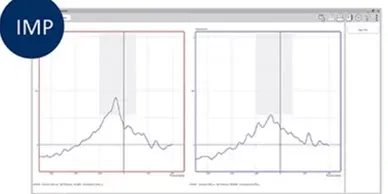
Tympanometry is a fast, objective middle ear test used to assess eardrum movement and middle ear function. It helps identify common causes of conductive hearing loss, including middle ear fluid (glue ear), Eustachian tube dysfunction, ear infections, negative middle ear pressure, perforated eardrums, and ossicular chain problems.
During tympanometry testing, gentle air pressure is introduced into the ear canal to measure how well your eardrum (tympanic membrane) moves in response to pressure changes. The test is quick, non-invasive, and does not require you to respond to sounds.
If your hearing test shows a difference between Air Conduction and Bone Conduction thresholds, tympanometry helps your audiologist determine whether the hearing loss is caused by a middle ear problem (conductive hearing loss) rather than an inner ear issue (sensorineural hearing loss).
Tympanometry is an essential diagnostic tool in comprehensive hearing assessments, allowing accurate diagnosis, appropriate treatment planning, and timely referral to your GP or ENT specialist when required.

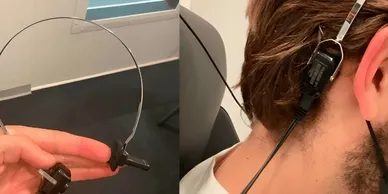
The next stage of your comprehensive hearing test is performed in a calibrated, soundproof booth using either headphones or insert earphones. This controlled environment ensures accurate measurement of your hearing across all key speech frequencies.
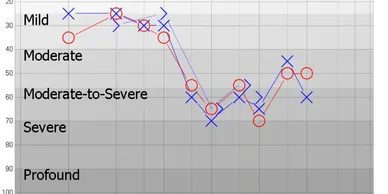
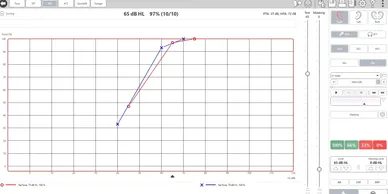
Air Conduction testing uses a series of soft “beep” tones at different pitches (frequencies) and volumes to determine your hearing thresholds — the quietest sounds you can detect at each frequency. These results form the foundation of your audiogram, which is the clinical graph used to diagnose hearing loss.
On an audiogram, red O symbols represent right ear Air Conduction results, and blue X symbols represent left ear Air Conduction results. By testing multiple frequency ranges (from low to high pitch), your audiologist can identify patterns such as high-frequency hearing loss, low-frequency loss, noise-induced hearing loss, or age-related hearing loss (presbycusis).
Accurate Air Conduction testing is essential for diagnosing sensorineural hearing loss, conductive hearing loss, or mixed hearing loss, and for determining whether hearing aids or further medical referral are recommended. This detailed assessment ensures personalised treatment and optimal hearing care outcomes.

Bone Conduction testing is an essential part of a comprehensive hearing assessment and is performed using a small vibrating device called a bone oscillator, placed on the mastoid bone behind your ear. This device sends sound vibrations directly through the skull to the inner ear (cochlea), bypassing the outer ear and middle ear.
By measuring your Bone Conduction thresholds, your audiologist can determine how well your inner ear is functioning independently of the ear canal and eardrum. These results are plotted on your audiogram and compared with your Air Conduction thresholds.
If there is a difference between your Air Conduction and Bone Conduction thresholds (known as an air-bone gap), it may indicate conductive hearing loss or mixed hearing loss, which can be caused by conditions such as ear wax blockage, middle ear fluid, Eustachian tube dysfunction, or ossicular problems. Identifying this difference is crucial, as some types of hearing loss may benefit from medical treatment or ENT referral.
Bone Conduction testing allows accurate diagnosis of the type and origin of hearing loss, ensuring you receive the most appropriate treatment plan and hearing care recommendations.

The next stage of a comprehensive hearing evaluation is speech testing, which measures how well you detect and understand spoken words — not just tones.
We begin with Speech Reception Thresholds (SRTs). During this test, you will hear a series of two-syllable words presented at gradually decreasing volumes. The goal is to identify the softest level of speech (in decibels) that you can correctly repeat 50% of the time. SRT results are compared with your pure tone audiogram to confirm overall test accuracy and hearing sensitivity.
Following SRT testing, we complete Word Recognition Testing (Speech Discrimination Testing). Using standardised recorded word lists (not live voice), you will hear single-syllable words presented at a comfortable, fully audible level. Your results are recorded as a percentage score, indicating how clearly your brain processes speech.
Higher word recognition scores indicate stronger speech clarity and speech understanding ability, while lower scores may suggest inner ear or auditory nerve involvement. These results are critical when diagnosing sensorineural hearing loss and predicting how well you are likely to perform with hearing aids, ensuring personalised treatment and optimal hearing outcomes.

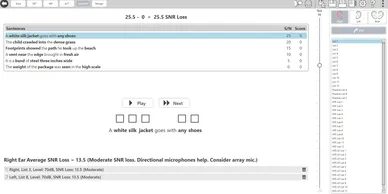
Speech-in-Noise (SIN) Testing is a Best Practice component of a comprehensive hearing assessment and is essential for evaluating your ability to understand speech in real-world listening environments. Many people with hearing loss say, “I can hear people talking, but I can’t understand them in background noise.” SIN testing objectively measures this difficulty.
Using validated tests such as the QuickSIN (Quick Speech-in-Noise Test), you are presented with sentences alongside increasing levels of background noise. The test determines how much louder speech needs to be above the noise — known as your Signal-to-Noise Ratio (SNR) loss — before you can correctly understand what is being said.
Speech-in-Noise testing can be performed with and without hearing aids, allowing your audiologist to measure treatment benefit and optimise hearing aid programming for challenging listening environments such as restaurants, social gatherings, and meetings.
Understanding your Speech-in-Noise score is critical for diagnosing speech clarity problems, hidden hearing loss, and age-related hearing loss (presbycusis).
It also guides advanced hearing aid features such as directional microphones and noise reduction technology, ensuring personalised care and improved speech understanding in background noise.

Do you struggle to hear and understand speech in noisy environments — even while wearing hearing aids? Difficulty hearing in background noise is the number one complaint among people with hearing loss.
ACT™ (Audible Contrast Threshold) testing is an innovative, evidence-based assessment designed to evaluate your ability to hear speech in noise. Unlike a standard audiogram, which measures the level of hearing, ACT measures the quality of hearing — specifically how well your auditory system processes sound contrast in challenging listening situations.
By performing ACT testing, your audiologist gains valuable insight into how much difficulty you may experience in restaurants, social gatherings, meetings, or other noisy settings. The ACT value helps guide personalised hearing aid fitting, particularly when programming advanced features such as adaptive directionality, noise reduction, and speech enhancement technology.
Fast and easy: ACT takes approximately two minutes to complete and can be performed alongside your routine hearing test.
Language-independent: ACT does not rely on speech or word recognition, making it suitable for all clients regardless of native language or dialect.
ACT testing supports truly personalised hearing care, ensuring your hearing aids are optimised not just for volume — but for clarity in noise.

Following your comprehensive hearing assessment, Alan will carefully review your results and discuss your personalised hearing treatment options.
Together, you will decide on the most appropriate solution based on your specific type of hearing loss, lifestyle needs, communication priorities, and long-term hearing goals.
If you have never previously received treatment for hearing loss, we recommend preparing a detailed audiology report outlining our clinical findings, diagnosis (such as sensorineural, conductive, or mixed hearing loss), and professional recommendations. This report is sent to your GP (General Practitioner) to ensure coordinated, evidence-based care.
We strongly encourage you to book an appointment with your GP to review the results. In some cases, further medical investigation may be required before proceeding with hearing aids — particularly if there are signs of asymmetrical hearing loss, sudden hearing loss, middle ear pathology, or other medical red flags. Your GP may recommend additional testing or referral to an ENT (Ear, Nose and Throat specialist).
This collaborative approach ensures you and your primary care physician make a fully informed decision about your hearing loss treatment plan, whether that involves hearing aid trials, medical management, or specialist referral — placing your health, safety, and long-term hearing outcomes first.

At AIM Hearing, we are an independent Hearing care clinic, which means we are not owned by any hearing aid manufacturer. Our priority is simple: helping you choose the best hearing aids for your unique hearing loss, lifestyle, and communication needs — not promoting one brand over another.
We strongly believe clients should have full control when making a final hearing aid decision. That’s why we recommend a minimum of two separate 7-day hearing aid trials, allowing you to compare leading hearing aid brands back-to-back in your real-world environments. This “apples to apples” comparison ensures you can assess speech clarity, comfort, background noise performance, Bluetooth connectivity, and overall sound quality in your daily life.
Every person’s hearing loss is different. What works exceptionally well for one individual may not be the best solution for another. By trialling multiple devices, you make an informed, confident decision based on real experience — not marketing claims.
It’s important to know that many hearing clinics are owned by hearing aid manufacturers and may only recommend their in-house brand. We encourage patients to always ask whether their clinic is manufacturer-owned.
Choose a clinic that prioritises independent advice, unbiased recommendations, and personalised hearing care — so you can select the hearing solution that truly works best for you.

At AIM Hearing, we follow international Best Practice hearing aid fitting standards, which include Real Ear Measurement (REM) — the gold standard for verifying hearing aid performance.
Real Ear Measurement is an advanced, evidence-based procedure that measures how your hearing aids perform inside your ear canal, not just what the manufacturer’s software predicts. Using a thin probe microphone, we objectively verify that your devices are delivering the exact prescriptive amplification targets required for your specific hearing loss. This ensures accurate gain across speech frequencies, resulting in better speech clarity, sound quality, and long-term hearing aid satisfaction.
Think of REM like a dyno tune for a high-performance car. A vehicle may be advertised as producing 400kW, but without independent testing, you’re simply trusting the brochure. When placed on a dyno, adjustments are often needed to reach true performance targets.
Similarly, hearing aid software estimates what your ears need — but every ear canal is acoustically unique. REM uses independent, third-party verification equipment to measure real-time output and fine-tune frequencies so they precisely match your prescribed targets.
Without Real Ear Measurement, hearing aids are programmed to prediction. With REM, they are programmed to precision — ensuring you receive the hearing performance you’ve invested in.
Our use of Real Ear Measurements offers several significant advantages:
- Improved speech understanding in various environments
- Reduced need for follow-up appointments
- Greater comfort and satisfaction with your hearing aids
The majority of professionally fitted hearing aids are programmed using Manufacturer First-Fit settings. First-Fit is a predictive starting point based on averages — essentially an estimate of how much amplification may be required for your hearing loss. However, research shows that relying solely on First-Fit programming can result in under-amplification, reduced speech clarity, and poor performance in background noise.
If you want to achieve the best possible hearing outcomes, your hearing aids should be verified using Real Ear Measurement (REM) — the gold standard in hearing aid fitting. At AIM Hearing, REM is a core part of our Best Practice protocol to ensure your devices meet your exact prescriptive amplification targets (such as NAL-NL3).
During REM, a thin probe microphone is placed inside your ear canal to objectively measure the sound output of your hearing aids in real time. We then adjust the manufacturer’s programming software to precisely match your prescribed gain across speech frequencies — ensuring accurate, personalised amplification.
Patients whose hearing aids are verified with Real Ear Measurement consistently report clearer sound quality, improved speech understanding in quiet and noisy environments, and greater overall satisfaction.
Real Ear Measurement is one of several evidence-based Best Practice procedures we provide at AIM Hearing — delivering hearing aid success rates that exceed industry averages and ensuring optimal long-term performance
No, REM is a painless and non-invasive procedure that takes only a few minutes.
Unfortunately, no.
Clients under the Hearing Services Program or DVA have protection as REM is a mandatory procedure when fitting under their strict guidelines but for private clients, Despite being REM being a best practice, many clinics don't utilize this important technology to save time for Private clients; We do.
The entire process typically takes about 30-45 minutes, depending on the complexity of your hearing loss.
Yes, we can perform REM on most existing hearing aids to optimize their performance.
We recommend repeating REM annually or whenever significant changes occur in your hearing.
No, Real Ear Measurement can only be performed in clinic and for those clients who have purchased devices online to same money; these devices have only been set to a "First Fit" program. That is why they cost less. It takes a trained professional with specialised and expensive equipment, their skillset and time to perform REM.
REM can dramatically improve the precision and satisfaction of hearing aid fittings. Clinics using REM are delivering best practice care that’s backed by decades of research and real-world outcomes.
We use cookies to analyze website traffic and optimize your website experience. By accepting our use of cookies, your data will be aggregated with all other user data.